
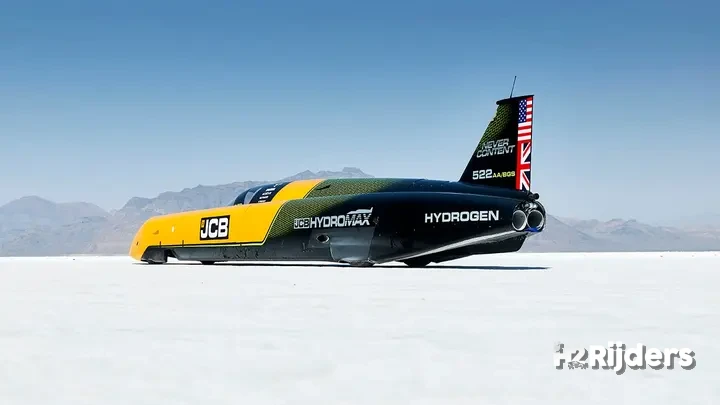
JCB 400 mph
On 11 August 2026 the JCB Hydromax averaged 406.320 mph — 653.909 km/h — across the Bonneville Salt Flats. The FIA confirmed the run as a world land speed record for a hydrogen-powered vehicle. The previous mark had stood since 2004: the BMW H2R at 185.5 mph (298.5 km/h). That record was not improved — it was more than doubled.
At the wheel sat Wing Commander Andy Green OBE, the same pilot who in 1997 became the first to break the sound barrier on land, and who set the diesel record with the JCB Dieselmax in 2006. He covered the measured mile in just under nine seconds, with runs of 400.623 and 412.135 mph. “This is the first of a new breed,” he said afterwards.
But the most interesting question about this record is not how fast. It is: why? Why does a maker of backhoe loaders send a streamliner to a salt flat in Utah?
A digger does not capture the imagination
JCB invested roughly £100 million over five years in hydrogen combustion engines. That is a great deal of money for technology almost nobody ever sees: a 55 kW (74 hp) four-cylinder, tucked into the engine bay of a 3CX backhoe loader on a building site. Chairman Lord Bamford named the problem himself. A digger simply does not capture the imagination, while a record car does: “Putting advanced engines into a land-speed car allows people to see the technology differently.”
So the record is not a sporting achievement that happens to run on hydrogen. It is a shop window for a development programme that would otherwise stay invisible — and a technical stress test at the same time.
The key word is 'production engine'
The same word appears in almost every JCB quote. Bamford: “This record was set by production-based engines, the same engines powering JCB diggers right now.” The two engines in the Hydromax derive from the series hydrogen engines JCB builds at Foston, Derbyshire.
Derived, not identical. To go from 74 hp to some 800 hp per engine, JCB and partners Prodrive, Ricardo and Xtrac changed the following:
- direct injection at 50 bar instead of port injection;
- double overhead camshafts instead of pushrods;
- an operating speed of around 4,500 rpm;
- roughly 100 kg saved per engine through aluminium components;
- four kilos of hydrogen in two composite cylinders at 700 bar;
- nearly 250 kg of ice on board to absorb the heat of each run.
What did not change is the architecture. That is the message: if the same engine concept survives a tenfold increase in power at full throttle on a salt flat, then that engine in a digger at 74 hp has headroom to spare. In that sense a record attempt is an experiment in margin. Green described engines running at a fuel ratio “no one had ever built for a hydrogen engine”.
Notably, JCB deliberately chose combustion over the fuel cell. After building fuel cell prototypes, the company concluded that for heavy equipment on muddy, remote sites that route demands extra batteries, electronics and cooling. For this application the familiar combustion architecture fitted better: fast refuelling, rugged, and no CO2 from the tailpipe. That is not a verdict on fuel cells, which are strong in cars and buses — it is a matter of the right technology for the job.
What is the equivalent of the first ocean crossing?
Demonstrations like this have a long history. They rarely invent anything new; they remove doubt. Three examples show the pattern.
1838: steam could not cross the ocean, until it did
In 1835 the British science populariser Dionysius Lardner calculated that a steamship could never travel much more than 2,500 miles: it could not possibly carry enough coal. The American lawyer Junius Smith spotted the flaw. Coal capacity grows with the cube of a ship's length, consumption roughly with the square. So build bigger. In April 1838 the Sirius sailed from Cork to New York in eighteen days; Isambard Kingdom Brunel's Great Western left four days later, took fifteen, and arrived with two hundred tons of coal still in the bunkers. Theory did not settle the debate — two ships in New York harbour did.
1919 and 1927: the air above the Atlantic
Alcock and Brown made the first non-stop flight across the Atlantic in 1919. Eight years later Charles Lindbergh did it solo, and only then did public perception truly shift. In the months after his flight, applications for a pilot's licence in the United States tripled and the number of registered aircraft quadrupled. Airline passengers grew from 5,782 in 1926 to 173,405 in 1929. The technology had barely changed; confidence had.
2006: diesel wins Le Mans
Closer to home, and closer to JCB. In 2006 Audi's R10 TDI became the first diesel car to win the 24 Hours of Le Mans, and repeated it in 2007 and 2008. Until then diesel was the fuel of delivery vans; afterwards a diesel engine could be sporting too, especially in the United States. In that same year of 2006, the same Andy Green drove the JCB Dieselmax to 350.092 mph — a record that still stands. That JCB is pulling off exactly the same trick twenty years later with a different fuel is clearly no coincidence.
What the record does and does not prove
To be fair: nine seconds over a measured mile says nothing about ten thousand operating hours on a building site, and nothing about whether a hydrogen refuelling point will be anywhere near that site. A record run tests peaks, not lifespan.
What it does show is that hydrogen combustion is controllable under extreme load: injection, mixture, thermal management, all at full power. And the record does not stand alone. The 3CX Hydrogen received European type approval through eleven national authorities, the first machines are rolling off the line, and JCB is opening a $500 million factory in San Antonio, Texas. Above all, the record is a loudspeaker for something that already exists commercially.
Hydrogen is having a decade of demonstrations
The Hydromax is not alone either. In October 2025 the FIA launched Extreme H, an off-road class built around the fuel-cell Pioneer 25. At Le Mans in June 2026 the liquid-hydrogen Toyota TR LH2 and the hydrogen-combustion Ligier JS2 RH2 ran demonstration laps; the ACO and FIA are aiming at a full hydrogen ruleset around 2028 or 2029. For hydrogen, racing and records are now what Le Mans was for diesel in 2006: a stage where technology proves itself to an audience that does not read technical reports.
The next barrier is no longer the engine
Green pointed at something else afterwards: hydrogen can be made from sunlight and water. That is where the remaining task lies. With an FIA stamp on it, the claim that the engine works is hard to dispute. The question shifts to the chain: green production, distribution, refuelling infrastructure and price. Exactly as with Lindbergh — first the flight, then the airports and the airlines.
We therefore read this record mainly as a marker in time. Alongside battery-electric driving, hydrogen is a second route to zero-emission mobility, and Bonneville made visible how much headroom that route still has. For heavy equipment working far from the grid, in places where grid capacity is scarce, and for applications where every kilo of weight costs extra energy, that is not a detail. It is an opening.
Sources
- FIA – FIA confirms new 406.320 mph World Land Speed Record for a hydrogen-powered vehicle (11 August 2026)
- JCB – Hydrogen-powered JCB Hydromax sets 406.320 mph world land speed record
- Fox News – JCB Hydromax shatters a world record with 'extraordinary' speeds topping 400 mph in hydrogen-powered car
- Octane – Inside JCB Hydromax: the making of a hydrogen record car
- Forbes – Hydrogen at 350 mph: JCB's high-speed bet on clean power (13 May 2026)
- Equipment World – JCB breaks speed record for hydrogen while using backhoe engines
- Motor Sport Magazine – The Audi R10 TDI: the trailblazing diesel racer that changed perceptions
- Transportation History – 1838: A steamship completes a trailblazing voyage across the Atlantic Ocean
- The Engines of Our Ingenuity – Steam across the Atlantic (Dionysius Lardner)
- Wikipedia – Lindbergh Boom
- RACER – Hydrogen-powered Toyota and Ligier prototypes set to run demonstration laps at Le Mans (3 June 2026)
- FIA Extreme H – Extreme H World Cup


